








CYCLE2CONNECT is the first European student cycling challenge that brings together sport, sustainability, and digital tools. Students form teams, track their cycled kilometers via a mobile application, and participate in workshops on sustainable mobility and an active lifestyle.
Special emphasis is placed on the inclusion of vulnerable groups and ensuring equal opportunities for participation for all.
The European Student Cycling Challenge project was designed by the Cycling Team ROG with the support of the City of Ljubljana and the European University Sports Association.
The project starts on March 1, 2026, and ends on August 30, 2027.
The project is part of the European Union’s Erasmus+ Sport programme and is co-funded as a large-scale non-profit sporting event.
Main Project Coordinator: Urška Pintar
Project Manager: Gorazd Penko
- Cycling Team Rog, Slovenia – Coordinator
- EUSA Institute, Slovenia – Partner
- Europlakat d.o.o., Mbajk Slovenia – Partner
- BTC Shopping Center d.d., Slovenia – Partner
- City of Ljubljana, Slovenia – Partner
- AV Living Lab, Innovative Technologies d.o.o., Slovenia – Partner
- Croatian Academic Sports Federation, Croatia – Partner
- Czech University Sports Association, Czech Republic – Partner
- French University Sports Federation, France – Partner
- University of Hamburg, Germany – Partner
- Hungarian University and College Sports Federation, Hungary – Partner
- CUS Venezia, Italy – Partner
- University Sports Federation of Macedonia, North Macedonia – Partner
- Student Sports Netherlands, Netherlands – Partner
- Academic Sports Association, Poland – Partner
- Turkish University Sports Federation, Turkey – Partner
- Aristotle University of Thessaloniki, Greece – Partner
General Objectives
- Promote regular physical activity among students through daily cycling.
- Promote sustainable mobility as part of the modern student lifestyle.
- Strengthen social inclusion and connections among young people from different European countries.
- Leverage a major international sporting event to promote a healthy and active lifestyle.
- Establish the European Student Cycling Challenge as an annual event encouraging sustainable mobility and student networking across Europe.
- Highlight the role of the European Union in supporting joint sports and sustainability initiatives.
Specific Objectives
- Encourage students to collect kilometers via a mobile application, participate in a team challenge, and qualify for the European Student Cycling Challenge, supported by a digital results-tracking platform.
- Organize a team cycling challenge in the center of Ljubljana using city bikes.
- Deliver educational workshops on sustainable mobility, health, and safe participation in traffic.
- Include vulnerable groups and ensure equal opportunities for participation.
- Collect participant feedback and develop recommendations for future European student cycling initiatives.
- Promote cycling as a long-term part of young people’s everyday travel habits.
Kilometer Collection and Team Challenge
Students collect cycled kilometers via a mobile application, form teams, and qualify for the final event in Ljubljana.
Team European Student Cycling Challenge in Ljubljana City Center
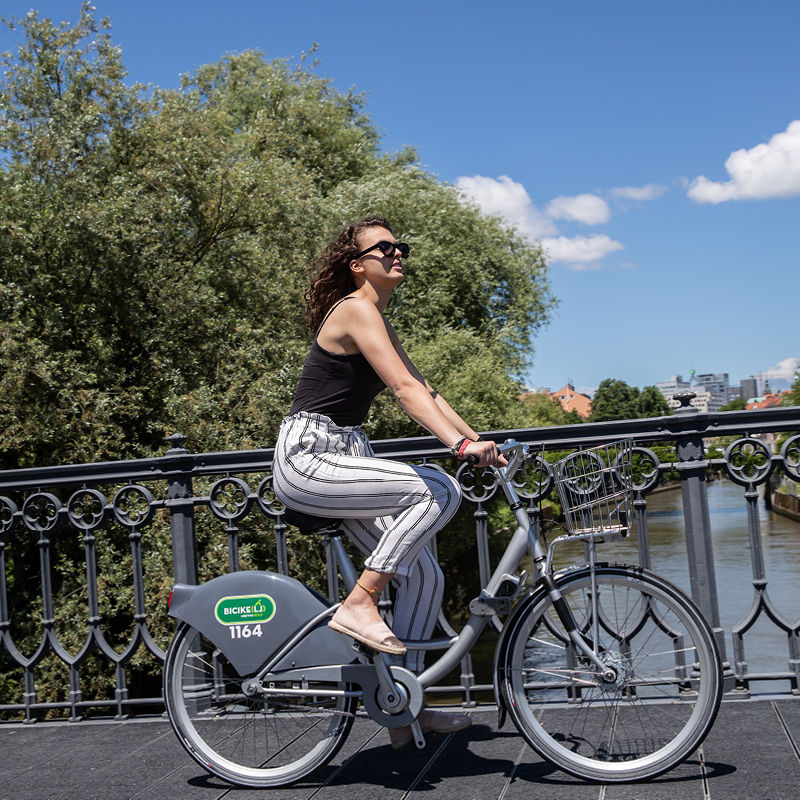
The final challenge will take place on June 10, 2027, as part of the Maraton Franja BTC City event, using the BicikeLJ city bike system and a group ride through the city.
Educational Workshops for Students
Workshops on sustainable mobility, healthy lifestyles, road safety, and inclusion of vulnerable groups.
International Networking of Students and Partners
Collaboration among universities, sports federations, cities, and other organizations from 12 countries, including the exchange of best practices.
Inclusion of Vulnerable Groups
Adapted activities and accessible participation formats to ensure equal opportunities.
Data Collection and Feedback
Monitoring participation, analyzing behavioral changes, and preparing recommendations for the further development of European student cycling initiatives.
Promotion of Sustainable Mobility
Communication activities encouraging daily cycling as an environmentally friendly mode of transport.

Expected Project Results
- A mobile application and digital platform established for tracking cycled kilometers and enabling student team participation.
- Active involvement of students from 12 countries in a joint European cycling challenge.
- Successful implementation of the European Student Cycling Challenge in Ljubljana city center as part of the Maraton Franja BTC City.
- Increased use of bicycles (including bike-sharing systems) as a daily mode of transport among students.
- Delivery of educational activities on sustainable mobility, health, and road safety.
- Inclusion of vulnerable groups and provision of accessible participation formats.
- Collection of data on young people’s mobility habits and participant feedback.
- Development of recommendations for universities and cities to further promote student sustainable mobility.
- Dissemination of project results among partners, students, and local communities across Europe.
Impact
CYCLE2CONNECT will contribute to long-term changes in students’ travel habits and increased use of bicycles as a daily means of transport.
The project will have a positive impact on:
- The health and well-being of young people by promoting regular physical activity through daily cycling.
- Sustainable urban mobility, by reducing dependence on cars and increasing the use of public bike-sharing systems.
- Social connectedness, by engaging students from different European countries in a shared team challenge.
- Inclusion of vulnerable groups and ensuring equal opportunities for participation.
- The development of sustainable digital habits through the use of a mobile app and kilometer tracking.